
Begum Khaleda Zia’s rise in Bangladeshi politics is far more than the story of a political leader ascending to the pinnacle of power. It is, at once, the story of a woman who moved from the confines of a private life to the centre of the nation’s political landscape; of a leader who forged her place in public life by confronting adversity; and of a defining chapter in the transformation of conventional perceptions about women’s political agency in Bangladesh.
Looking back today on her long and eventful political career, one fact stands out: Khaleda Zia did not enter politics through any of the conventional routes. She was neither a familiar face in student politics nor a politician groomed from an early age as the heir to a political dynasty. For years, her life as a homemaker revolved largely around her family, household and children. Yet history sometimes places upon individuals responsibilities for which they have neither sought nor prepared themselves. In Khaleda Zia’s case, that moment came with extraordinary force.
Her political journey began against the backdrop of the turbulent reality that engulfed Bangladesh following the assassination of her husband, former President Ziaur Rahman. Confronted with profound personal grief, she was nevertheless compelled to step into the public arena as the Bangladesh Nationalist Party (BNP) faced a crisis over its very survival and future. As she gradually established herself at the helm of the party, she found herself navigating two formidable challenges simultaneously: intense internal tensions within the BNP and an increasingly restrictive political environment under military rule.
This is where the first great significance of Khaleda Zia’s political story lies. She did not enter politics driven by the allure of power; she was propelled into it by circumstance. Yet transforming an opportunity born of circumstances into a position of political leadership required a formidable degree of resolve—and that was precisely what she demonstrated.
In the early 1980s, Bangladesh was under military rule. When Hussain Muhammad Ershad seized power in 1982, the country’s democratic politics entered a new and turbulent phase. Restrictions were imposed on political parties, political activities were curtailed, and the growing concentration of power at the centre gradually intensified opposition on the streets. It was on those streets, amid protests, repression and political confrontation, that Khaleda Zia’s political identity was truly forged.
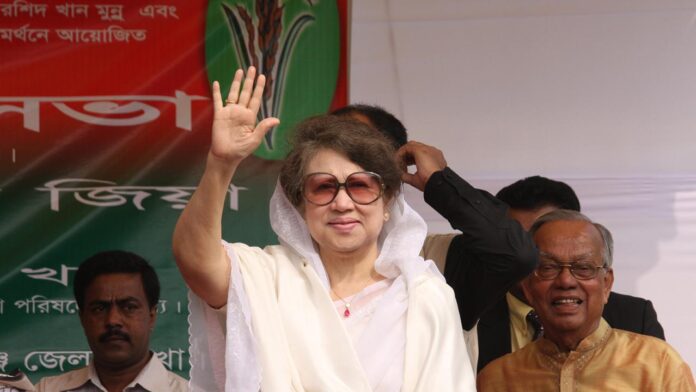
She did not merely participate in party programmes as the chairperson of the BNP; she emerged as one of the principal leaders of the anti-Ershad movement. Through rallies, public meetings, marches, strikes and repeated arrests, her identity gradually evolved from that of a homemaker into that of an uncompromising political leader.
To understand Khaleda Zia at this stage of her life, however, one must also remember the social realities facing women in Bangladesh at the time. Women’s participation in politics was far more limited than it is today, while the political arena remained overwhelmingly male-dominated. Against that backdrop, a woman standing regularly on the streets and leading political protests was more than an episode in party politics. It signalled a shift in the social imagination of what women could achieve in public life.
The mass uprising of 1990 marked the defining turning point in that political journey. The BNP, the Awami League and other political parties were all active in the anti-Ershad movement, each from its own political position. Eventually, confronted by an overwhelming popular mobilisation, the Ershad government fell, opening a new chapter in Bangladesh’s democratic politics.
Then came the 1991 general election. When the BNP emerged victorious, Khaleda Zia assumed office as Bangladesh’s first woman prime minister. The journey of a homemaker to the country’s highest executive office was undoubtedly a landmark in Bangladesh’s social and political history.
To view this merely as an electoral victory for the BNP, however, would be to overlook much of its historical significance. Across South Asia, doubts and reservations about women in positions of political leadership remained deeply entrenched. The emergence of a woman as prime minister in Bangladesh challenged those assumptions in a powerful and highly visible way. Women had already participated in politics, led movements and served in parliament. But taking charge of the government and assuming the highest responsibility for running the state represented an entirely different order of political achievement.
Khaleda Zia’s first government also coincided with a significant transformation in Bangladesh’s system of governance. Following the political changes of 1991, the parliamentary system of government was restored. The country moved away from a presidentially centred model of governance and returned to a system in which the prime minister and parliament occupied the central position in running the government.
For Bangladesh’s democratic journey, it was a defining chapter.
Khaleda Zia’s political defeat in 1996 did not drive her from public life. She returned as leader of the opposition, spent the following five years rebuilding and consolidating the BNP, and led the party to victory in the 2001 general election. When a BNP-led four-party alliance formed the government, she returned to office as prime minister for a second time.
Her political longevity as a woman was particularly striking. Holding on to political leadership in Bangladesh is never easy; for a woman, the obstacles have historically been even greater. Yet Khaleda Zia retained her position at the centre of the BNP for decades. It was also during this period that much of her personal popularity beyond the formal structures of party politics took shape.
But the most difficult chapter of Khaleda Zia’s life began after she left office.
In 2007, when a military-backed caretaker government assumed power, the country’s two leading political figures, Khaleda Zia and Sheikh Hasina, both came under intense political and legal pressure. Khaleda Zia was arrested. Imprisonment, court cases and prolonged political uncertainty would define some of the most difficult years of her life.
When the Awami League subsequently returned to power, the BNP moved into opposition and political confrontation intensified. The BNP boycotted the 2014 general election. Ahead of the 2018 election, Khaleda Zia was imprisoned in corruption cases. After spending a prolonged period behind bars, her deteriorating health led the government to suspend her sentence through executive action, allowing her to remain at home.
The Khaleda Zia of these years inhabited a reality dramatically different from that of the street-fighting opposition leader of the 1980s. Age, illness, imprisonment and political isolation had taken a heavy physical toll. Yet her political identity did not disappear. If anything, her illness and imprisonment became one of the most powerful emotional focal points of BNP politics.
This is where another defining feature of Khaleda Zia’s life comes into view: endurance.
Across a long political career, she experienced defeat, lost power, led movements, faced arrest, spent time in prison, fought legal battles and struggled with deteriorating health. Yet she never completely withdrew from politics.
The political changes of 2024 opened another chapter in her life. She gained an opportunity to move beyond years of legal complications, while courts subsequently delivered decisions in several of the cases brought against her. By then, however, her physical condition had become extremely fragile. In the final years of her life, she received medical treatment both at home and abroad. Her death on 30 December 2025 brought an end to an era in Bangladesh’s politics.
But her death inevitably raises a larger question: what is Khaleda Zia’s political legacy?
The answer cannot be found solely in election results, her years as prime minister or the organisational strength of the BNP. To do so would be to leave out perhaps the most consequential dimension of her legacy: what her political ascent represented for the women of Bangladesh.
Khaleda Zia rose to the summit of politics at a time when the social space available to women outside the home was far narrower than it is today. Her life demonstrated that the assumption that a woman’s destiny ends with the responsibilities of family and household can be overturned by the demands of history. A woman could stand at the centre of national politics, lead a major political party and assume the highest office of the state.
In that sense, Khaleda Zia’s identity as a “housewife” should not be viewed as a symbol of limitation. Rather, it represents one of the most striking paradoxes of her political rise. She demonstrated that the boundaries society draws between the household and the state are not always boundaries that history respects.
For millions of Bangladeshi women who manage households, raise children and carry the responsibilities of family life, Khaleda Zia’s political ascent offered a powerful and visible message: a woman’s identity within the home does not have to be the final measure of her potential.
There is another important dimension to her political legacy. Khaleda Zia inherited a political opening, but she had to transform that inheritance into leadership of her own. Being the wife of Ziaur Rahman opened the door to her entry into BNP politics. But maintaining control of the party for more than four decades, leading movements on the streets and winning elections to form governments on multiple occasions cannot be explained by family identity alone.
That is where her own political abilities, determination and capacity for decision-making come into focus.
Yet the task of history is neither simply to praise nor to condemn. Its task is to understand an individual within the circumstances of her time. Seen from that perspective, Khaleda Zia is an indispensable figure in the political history of Bangladesh. Whether one agrees with her politics or not is a separate question. But explaining the country’s politics over the past four decades without accounting for her role is exceedingly difficult.
Her place in the history of women’s leadership is even more pronounced. When a woman becomes prime minister for the first time, it is not merely an individual victory. It can alter the psychological boundaries of an entire society. Subsequent generations of women are able to see, in concrete terms, that the highest office of the state is not beyond their reach.
To view Khaleda Zia solely through the lens of the BNP–Awami League rivalry is therefore to miss much of her wider social significance. She was a woman who emerged from profound personal adversity to assume national leadership. She led movements in the streets, came to power, lost power and returned to office. She was imprisoned, fought prolonged legal battles and remained politically consequential until the final years of her life.
Her life was therefore a story of achievement, but also of struggle. It was a story of power, but also of life outside power. It was a story of political victory, but equally of returning from defeat.
Ultimately, the aspect of Khaleda Zia’s life that deserves perhaps the greatest attention is the visible symbol of female leadership that she became for Bangladesh.
From an ordinary homemaker, she rose to become the chairperson of one of the country’s largest political parties. From the streets of the anti-authoritarian movement, she rose to become prime minister. She traversed almost every terrain of political life—from the centre of state power to the confines of imprisonment. Yet her political identity was never completely erased.
Whatever judgments history ultimately passes on her political career, one fact is likely to remain unmistakable: in the history of women’s leadership in Bangladesh, Begum Khaleda Zia is an unavoidable name.
Future generations may remember her as more than a former prime minister. They may remember her as the woman who demonstrated that the life of a homemaker, too, can one day alter the course of a nation’s history.
And perhaps that is the most enduring inspiration of Khaleda Zia’s life.
Society may continue to regard a woman’s primary role as managing the home. But that is a social convention, not the final word of history. A woman can step beyond the household and lead a country. The life of Begum Khaleda Zia stands as a long, difficult and historic testament to that possibility.
The writer, Ruhul Amin, is Central Vice-President of Bangladesh Nationalist Publicity Party