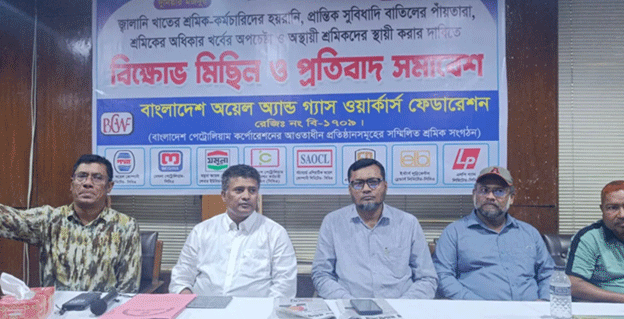
Bangladesh Oil and Workers Federation Secretary General and Jamuna Oil Company Limited (JOCL) Labor Union General Secretary Muhammad Ayakub has expressed full confidence in Prime Minister Tarique Rahman’s decision-making regarding the proposed private-sector import of refined fuel oil, saying that the national interest and workers’ rights must remain at the centre of any such move.
Speaking at a rally in Chattogram on Sunday, Ayakub said Bangladesh should give priority to its own interests while considering private-sector participation in refined fuel oil imports. He said the government’s “Bangladesh first” policy should also guide decisions concerning the country’s energy sector.
“There has been talk recently about importing refined fuel oil in the private sector. The Prime Minister has said, ‘Bangladesh first’. We also want to say the same—‘Bangladesh first’,” Ayakub said.
He noted that crude oil is already being imported into Bangladesh through private-sector arrangements. In the case of refined fuel oil, however, he stressed that any decision should be assessed from the perspective of the country’s economic interests, consumer welfare and the rights and interests of workers in the energy sector.
“We want that in any decision taken in this regard, the welfare and interests of the country and the people should be protected along with the rights of the workers,” he said.
Ayakub added that he hoped the Prime Minister would consider these issues before making a final decision on private-sector refined fuel imports. “We have full confidence in the Prime Minister’s decision. We have no objection to this,” he said.
He made the remarks at a rally organised after a protest procession demanding an end to harassment of workers and employees in the energy sector and implementation of their various demands.
The programme began at around noon at the Jamuna Oil Company Limited office, Jamuna Bhaban, in Agrabad, Chattogram city. Workers and employees from different organisations across the energy sector, including JOCL, took part in the rally.
Addressing the gathering, Ayakub alleged that vested interests within the government were attempting to create instability in the energy sector by interfering with workers’ rights and existing benefits.
He claimed that efforts were being made to reduce 22 specific benefits currently enjoyed by workers, while delays in updating those benefits through bilateral agreements were also creating frustration among employees.
According to Ayakub, the government has spoken about ensuring fair benefits for workers and has undertaken several initiatives in this regard. But, he alleged, a different situation is emerging in companies under the Bangladesh Petroleum Corporation (BPC), including Padma Oil, Meghna Petroleum, Jamuna Oil, Standard Asiatic Oil Company Limited (SAOCL) and LPG-related enterprises.
“Instead of increasing the existing facilities and benefits of workers, there are attempts to reduce them,” he said.
He further alleged that various methods were being used to restrict labour leaders representing workers and employees in their efforts to secure legitimate rights. Such measures, he said, could undermine industrial peace in an already sensitive sector.
“Workers and employees want peace in the energy sector. But even though we want peace, a malicious group lurking within the government is trying to create unrest in this sector by taking away the rights of workers,” Ayakub said.
He warned that workers would not accept attempts to create instability in the energy sector and said employees were seeking only their legitimate rights, an end to harassment and an environment free from unnecessary interference.
The labour organisations also outlined several reasons behind their protest programme. They said salaries, allowances and other facilities for workers and employees of BPC’s oil-marketing companies are generally updated every two years through bilateral agreements. However, although the previous agreement has already remained in force for 19 months, a new agreement has yet to be concluded because of what labour leaders described as negligence and delays by the concerned companies.
The workers also objected to the proposed Marginal Benefits Policy-2026 (Draft), saying the initiative could reduce 22 existing benefits. They said the Energy and Mineral Resources Department raised the issue on June 17.
Another major concern involves proposed changes to provisions of the Bangladesh Labour Act-2006 concerning industrial disputes and their settlement. Labour leaders said attempts to repeal Sections 209, 210 and 211 could weaken the authority of Collective Bargaining Agent (CBA) leaders who represent workers in negotiations over their rights.
Workers have also expressed concern over an office order issued by the Mineral Resources Department on July 26, under which an eight-member committee was formed to monitor the activities of labour organisations in oil-marketing companies and make recommendations regarding accountability.
The labour leaders said the move had generated anxiety among employees working in the strategically important energy sector.
They also raised concerns about contractual workers employed by different companies on a “no work, no pay” basis for very low wages. According to the leaders, these workers are not being given adequate priority when manpower is recruited for regular positions.
The meeting was chaired by JOCL Labor Union President Abul Hossain. Among those present were Padma Oil Workers’ Union President Jasim Uddin, LPG Workers’ Union President Monir Hossain, BPC Workers’ Union Joint General Secretary Kamrul Islam, Padma Oil Workers’ Union Office Secretary Selim Kabir Chowdhury and JOCL Labor Union Deputy General Secretary Syed Mohammad Mannan.
The Bangladesh Oil and Workers Federation is the apex organisation representing workers and employees in the country’s oil and gas sector. It brings together the CBA organisations of BPC, Padma Oil Company Limited, Meghna Petroleum Corporation Limited, Jamuna Oil Company Limited, Eastern Refinery Limited, Standard Asiatic Oil Company Limited and LP Gas Limited.
The federation’s latest position indicates that while energy-sector workers are not opposing private-sector participation in refined fuel imports, they want the government to ensure that such a policy serves Bangladesh’s national interests while safeguarding the legitimate rights and benefits of the workers who remain central to the country’s fuel supply and distribution system.