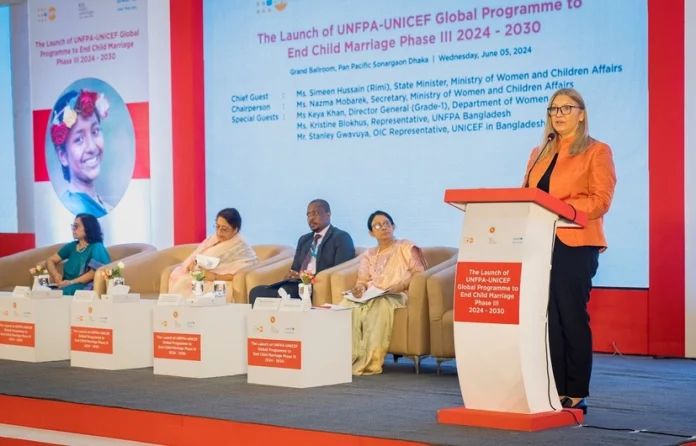
The Ministry of Women and Children Affairs in Bangladesh, in collaboration with UNFPA and UNICEF, launched the Phase III of the joint Global Programme to End Child Marriage (GPECM).
Set to run till 2030, the Global Programme targets the most marginalised communities across the country and aims to bolster resources and sharpen focus to support the Government of Bangladesh on its endeavour to end child marriage.
While addressing the launching event Simeen Hussain (Rimi), State Minister, Ministry of Women and Children Affairs said, “Eradicating child marriage is a cornerstone of our commitment to safeguarding the rights of children in Bangladesh. We commend the collaborative efforts of UNFPA and UNICEF and affirm our commitment to working closely and effectively to implement the National Plan of Action to End Child Marriage and roll out the Child Marriage Restraint Act. We also must focus on the behavioural aspect for changing people’s outlook as law alone cannot change what is being practiced for long.”
The premier of Bangladesh has publicly pledged to abolish marriages for girls under the age of 18 by 2041. Supporting the government, the Global Programme will leverage multi-sectoral, scalable, and evidence-based interventions to ensure the full execution of the National Plan of Action to End Child Marriage.
“Currently, the rate of reduction of child marriage in Bangladesh is only 2.1 % per year, which means it will take Bangladesh over two centuries — 215 years — to eliminate child marriage,” said Kristine Blokhus, Country Representative to Bangladesh.
“Keeping girls in school is a game changer. Increased, targeted investments in sexual and reproductive health services and comprehensive sexuality education equip adolescent girls with the tools to make informed decisions about their bodies and lives and empower them as agents of change and future leaders,” she added.
“UNICEF is entering this new phase with a renewed commitment to empowering every child, especially rural adolescent girls and young women with life skills,” said Stanley Gwavuya, OIC Representative of UNICEF in Bangladesh.
“Working in districts with a high prevalence of child marriage, we will work with partners to address the root causes, engage key actors, and provide comprehensive support to both unmarried and married adolescent girls.”
During the previous phases, UNFPA and UNICEF collaborated closely to assist the government in reaching 5.5 million girls, analysing factors driving child marriage, empowering grassroots organisations, and strengthening services and protection for vulnerable girls in Bangladesh.
Over the next four years (2024-2027), UNFPA and UNICEF aims to achieve significant milestones through the joint work plan by engaging over 1,200,000 adolescent girls (aged 10-19) in life skills or comprehensive sexuality education (CSE) interventions.
.